
From my blue chair . . .

Visiting the Elements — Earth
In these times that seem senseless in so many ways, the element of Earth gives me faith.
Surviving is important. Thriving is elegant.
Maya Angelou
Earth - So central to our lives that we take it for granted
Looking at how the essential elements on this beautiful planet can help us respond to these tumultuous times. This is the final in a series on visiting the elements. The last post explored Fire; today we’ll be visiting Earth.
In these times that seem senseless in so many ways, the element of Earth gives me faith. Today, I'm going to muse on the Earth element and share a few practices that call in the Earth element.
Earth is the beautiful planet that is our home. Earth elements include minerals, stone, humus. Earth gives us a sense of ground. It is also the living layer of soil that supports us so beautifully by giving rise to the greening, the trees, and plant life. Earth's magnetic field orients how we move and experience up and down, as well as forward and backward.
Earth is this beautiful planet that is our home. The Earthrise Image of our planet, taken from space in 1968 circulated widely and shifted our collective perspective. This image provided our consciousness with a subject-object move — we were offered the opportunity to look at ourselves from the outside. A planetary world view arose. With that image taken from beyond our atmosphere, a burgeoning sense of awe propelled a movement to protect the environment.
Earth is fundamental and enduring. Earth as an element is the essence of form and structure. Earth offers us nurturing support and the ability to create a strong foundation. Earth as an element is a symbolic representation of Truth. Feeling grounded is a result of being connected to the Earth. When we feel grounded, we are more willing to see things as they are and are more willing to be present with what is. When we speak the Truth, we are calling in the Earth element. Truth, whether it be a hard truth or a beautiful one, is a grounded perspective.
Earth is nurturing. Earth in the form of the soil that blankets our landforms is one of the most complex life-affirming biomaterials on the planet. When it is healthy, one teaspoon of this crumbly humusy layer contains more organisms than there are human beings on the planet. The health of our soil is critical to our survival. Civilizations have risen and fallen based on the health of the soil on which they depended. The failure of the Sumerians, Mayans, Indus Valley civilizations, along with the Roman Empire was, in large part, a failure to contribute to the soil. In the United States, the Dust Bowl in the 30s was a direct result of unsustainable farming practices combined with the inevitable cycles of drought in the Midwest. Conversely, civilizations that developed agricultural practices to manage soil health sustained their populations for a much longer arc: the ancient Egyptians, the Incas, and areas in Asia. Soil is a living organism, a layer that surrounds the Earth and gives life. This nurturing aspect of the Earth element requires the practice of reciprocity. ( Look for the book Soil by Matthew Evans for more on this . . . )
Earth has a magnetic field that orients our physical selves, perspective, and worldview. One of the most remarkable aspects of living on this planet is something we all depend on with each step: Gravity. Gravity asks nothing of us – it only holds. It is what we push off against when we walk. If it weren't for gravity, we would not have uprightness, nor would we fall to the ground. Gravity provides us with the fundamental perspective of above and below. Just watch the astronauts float around in a spaceship, and you will get a glimpse of the human body with no sense of up and down.
The element of Earth offers us a steady gravitational pull, solidity, and a connection to matter. Where air and water are mutable, Earth is substantial. In martial arts, we learn to lower our center of gravity to ground ourselves to be unmovable, but also to spring from the ground to kick and parry. Earth gives rise to the power in any action on this planet.
As I write here, I'm struck by how Earth is so central to our lives that we take it for granted. We remember, and then we forget that the very ground we walk on is a living being that sustains us. Remembering and forgetting are such a part of the human experience, and so too is practice . . .
Foundation Practices to connect with the Earth element:
How do you sit? Enhance your awareness of your connection to the Earth by paying attention to how you sit. Sit upright with your sitz bones nestled firmly on a cushion or even the ground. Your pelvis is slightly forward to allow for an easy curvature of your spine, and then straighten gently towards the sky. Here you sit between heaven and Earth.
Pay attention to your feet as you travel across the surface of this Earth. Consider that you are making use of and defying gravity with each step — a walking miracle.
Guided Meditation - Registering Gravity’s Embrace: Click here for a recording I made a number of years ago. It requires finding a quiet place where you won't be disturbed for 15minutes or so. I find that it alleviates anxiety and invites me to a somatic experience of faith. With gratitude to Reginald Ray.
Engage with the Dirt: Take those gardening gloves off and let the soil get under your fingernails. Walk barefoot on the ground. Revel in the richness of this Earth element. How well are you enjoying and caring for this fundamental element? is this soil being replenished or enriched?
Focus Practices: Grounded Communication
Speaking the Truth: Begin challenging conversations with what you observe with as much clarity as you can. Many of us have the habit of starting with how we feel, which often causes conflict to escalate. Starting with the data and then moving to how you feel sets a trajectory for better outcomes.For more, Clean Talk.
Use sentence stems such as:
I observe . . .
I notice . . .
Finding your Yes and your No. Practice clear communication of yes and no. Even in uncertainty we can find a way forward with this practice. A great resource for this practice is William Ury’s book Getting to Yes.
Look for opportunities to . . .
Communicate an earthbound yes
Communicate an earthbound no
Saying no on behalf of an important yes
Examples:
“I don’t know what is going to happen, but I can say ‘yes’ to going dancing tonight”
“No, I’m not willing to participate in that injustice. “
“No, I’m not going dancing tonight, because I have a project I want to finish.”
May we find an elegant way forward in these uncertain times . . .
June 28th 2025
Putney, Vermont
What Makes Sense
by Carrie Newcomer
I pledge alliance to a drop of dew
Wobbling on a broccoli leaf,
To the silver pattern on a zucchini frond
A perfect spiral at the center of a cabbage head.
I bow my head to the licorice smell of fennel filagree,
The taste of rounded peas and knee-high corn
And the perfect dun of barley hay.
I namaste a row of beans,
To garlic scapes and turnip greens
To the sweetness of sweet potato vines
To the last red radish and first blueberry.
I lift up my face to the summer sky
The sound of larks
And the feel of dirt
To all that keeps making sense
In senseless times.

Visiting the Elements — Fire
Fire illuminates, warms, burns, destroys and gives life.
Fire - The stars that guide us and the hearth that holds us
Looking at how the essential elements on this beautiful planet can help us respond to these tumultuous times. This is the second in a series on visiting the elements. The last post explored Air; today I’ll be musing on Fire.
Perhaps humanity's earliest technological advance was the ability to harness the power of Fire. Stealing the element of Fire for the benefit of humanity is a narrative found across cultures, from Prometheus in Greek mythology to Māui in Polynesian stories. In Cherokee myth, Grandmother Spider snuck into the land of Light and took some Fire away in her net. Coyote, Beaver, Dog, Rabbit, Crow, and Possum are all credited with stealing Fire and bringing it to humans. All of these stories hold a deep respect for the power of Fire — There is heroic sacrifice and divine punishment. In each, the transformative power of Fire advances human progress and brings unintended consequences.
The forge is one of the earliest technologies for capturing Fire. When we make use of metal, we are benefiting from the captured Fire in the forge. Smiths learned to temper and form bronze using Fire. Warriors have made use of Fire to create the sword, the dagger, the shield. In this century, we have advanced to developing explosive firepower and nuclear technology that requires a degree of responsibility we have not yet evolved far enough to fully accept. As the stories that have come down through the ages have shown us, Man is compelled by the power of Fire. He plays with Fire at his great benefit and his peril.
In the feminine narratives, women tend Fires. Whenever we cook or warm our homes we are working with the transformative power of Fire that was captured for our benefit. Hestia is the powerful and now lesser-known Goddess of the Hearth in Greek and Roman mythology. The hearth is a fundamental placeholder for the Fire that benefits humanity. Before we invented Fire starters, we had to keep the Fire burning so as not to lose the transformational power of this element. The hearth is a warm and inviting place that is the sacred center of the Home and Temple in many traditions. A place where what we value and care about is kept burning.
Fire helps us stay true to our vision and purpose through its magnetic quality in the heart of our homes and the warmth in our beings. The affirming warmth and support of home. The Fire in our belly. Fire also assists us with developing vision and purpose through the inspiration of light in the heavens. The stars help us to stay on course. Fire in the heavens inspires us to reach beyond our small selves. Illuminating the vast possibility that is beyond Earth's atmosphere and our imaginations.
It is no wonder that in our achievement-oriented culture, we privilege this element above all. We must have “fire in our belly” and “guiding stars” to achieve our longings and callings
Fire Practices
Create a hearth fire in your backyard and invite people to gather around it. Notice what happens in the space around the Fire. Consider the lineage of humans to which you belong who have been gathering around Fires in this way for millennia.
Show up for the moment that the sun rises and or sets during the solstice. What occurs in that moment inside you and around you? Consider that human architects have been orienting around this moment in time cross-culturally for millennia. Stonehenge, Machu Picchu, Hovenweep . . .
"Barn's burned down,
Now I can see the moon.”
Masahide (often attributed to Basho)
And looking to the Fire Masahide alludes to in his famous poem. Think of a time when your barn burned down – when Fire was a destructive force in your life, either actually or metaphorically. What rose up from those ashes? What possibilities emerged? In what way did you see the moon?
On this the 20th day of June 2025, May there be fire in your belly!
Next up in this four part series is the Element of Earth.
See the rest of the four-part series here . . .
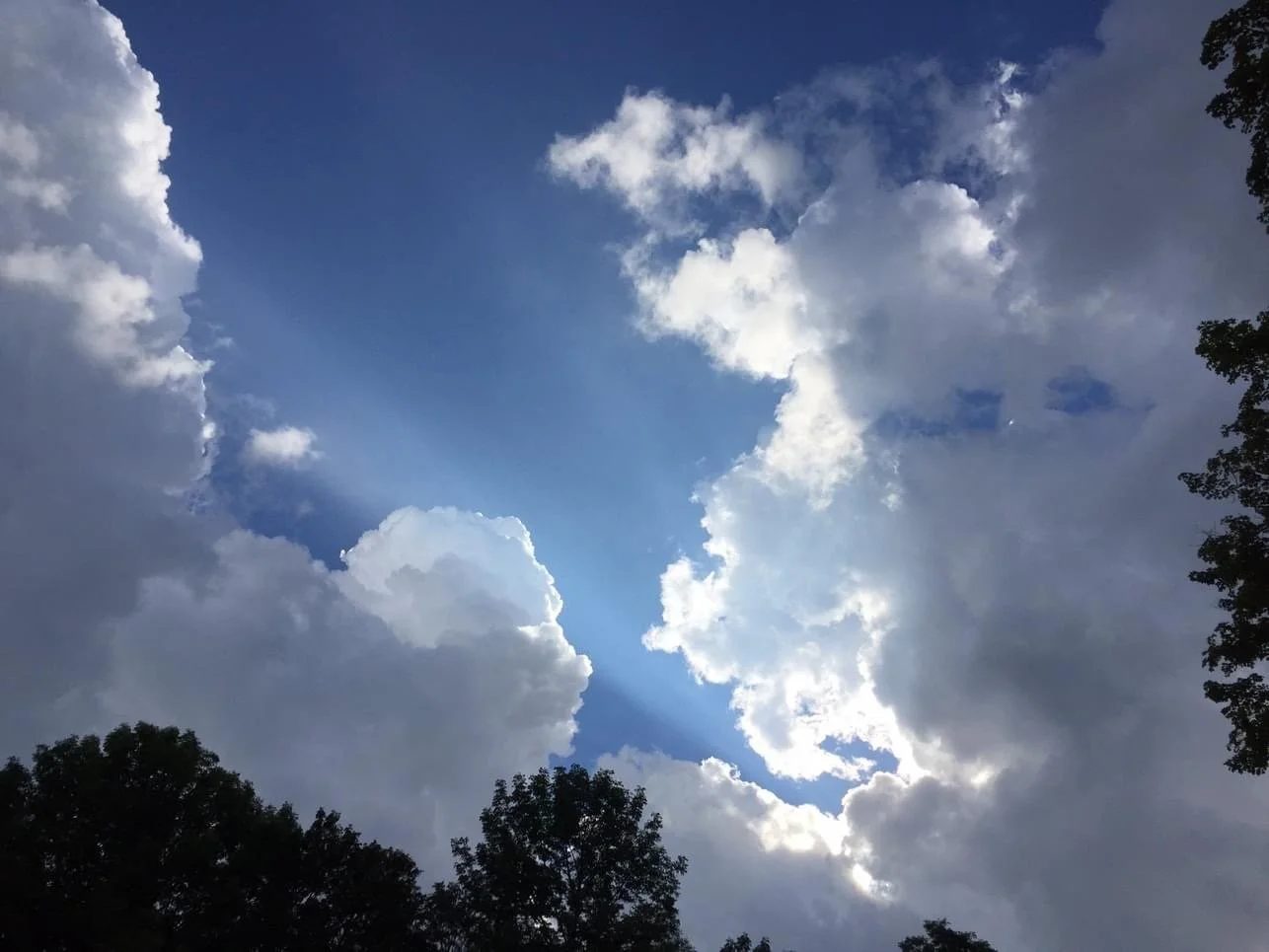
Visiting the Elements — Air
Where water offers us moisture and connection, Air provides us with oxygen and spaciousness.
Dwell in possibility . . .
Emily Dickinson
Air - Breathing and the value of the space between
Looking at how the essential elements on this beautiful planet can help us respond to these tumultuous times. This is the second in a series on visiting the elements. The last post explored Water; today we’ll be visiting Air.
Where water offers us moisture and connection, Air provides us with oxygen and spaciousness.
Being composed of invisible gases, Air reveals itself through movement. It breezes and blows. Winds prevail, gust, and subside. Air, like water, is mutable. Where water responds to gravity, Air responds to differentials in pressure and temperature—moving through updrafts and downdrafts. Water is dense. Air is nebulous. Air is hard to define; it is, after all, the Air we breathe. Unseen, ever-present, Air is always felt by its presence or absence.
Let's look at Air as the substance we breathe, the mysterious element that wraps around our beautiful planet, and as the element that gives us a felt sense of spaciousness.
Fundamentally, Air is atmospheric. Air (from the ancient Greek "aer," meaning wind, atmosphere) isn't something we see. It is a life-giving, invisible gas that makes itself known to us through movement and a felt sense of space. The thin layer of atmosphere is primarily composed of three main gases: nitrogen, approximately 78%; oxygen, about 21%; and Argon, about 0.93%.
With that first breath, Air enters us. We begin to fully participate independently as human beings — we become by breathing in Air. Breathing in and out is participatory. We receive oxygen and offer carbon dioxide with each breath. We need oxygen, and plant life requires carbon dioxide to support its photosynthesis. When you go for a walk in the woods, you are in reciprocity with the plant life through your breathing. This is respiration.
In these BANI times, mindful breathing supports responsiveness over reactivity. It calms and integrates the mind, which is the foundation of creativity, according to Daniel Siegel, a renowned neurobiologist, in his book The Mindful Brain. Breath connects us to the present and to others, expanding our capacity for insight and innovation. Breath literally re-spirits us.
Giving loving attention to the breath, its rhythm and depth, supports us in being our most resourceful and fully human selves.
Breathing is our intimate relationship with the element of Air and life itself. When we take our last breath, the spirit leaves us.
The late neurosurgeon Paul Kalanithi wrote a beautiful memoir, When Breath Becomes Air, about the preciousness of time, life, and breath. (Tissues may be needed . . . )
*. * *
I can't talk about Air without talking about spaciousness.
Between stimulus and response there is a space.
In that space is our power to choose our response.
In our response lies our growth and our freedom.
Attributed to Victor Frankl
Air offers us the experience of spaciousness and expands things with its presence. Air gives us access to the quality of awareness itself. How often do you think or say . . .
"Can you give me a minute?"
"I'd like to sleep on that."
"Let's take a walk; I need some air."
Human beings need space in order to expand their awareness. Our attention tends to be aware of form and unaware of space. When we think of a house, we think of the form of the building itself and the things in it. This is why we tend to fill space so readily, in our rooms, in our calendars, and our minds. When we think of a home, we might think about the space it offers us. Space is where possibilities arise . . .
Learning to shift our focus to space can be a life-changing experience. Here are some ways to do that:
Plan for some nothingness: chunking time to step away from clock time and get into a flow — to do or not do anything in particular with all the lists set aside — is one way to start. I call this 'puttering,' and I try to have four hours of it every weekend, along with at least one hour a day. Sometimes, it turns out to be productive in unexpectedly marvelous ways.
Clearing the clutter in our homes and workspaces is another way. Just cleaning out a drawer in the kitchen or taking the trash off-site gives rise to an energetic shift and a good feeling in me. How about you?
Open Focus Training: If you want to explore Air further, then working with paying attention to the space between is a powerful perspective-shifting practice. Dr. Les Fermi and his colleagues have written extensively on this, and I highly recommend their books and the practices they offer.
A key practice outlined in his book, Open Focus Brain, is the "Expanding Awareness" exercise, which helps shift attention from a narrow, effortful focus to a more diffuse, relaxed state—what Fermi calls Open Focus. This state is associated with synchronized alpha brainwaves and can reduce anxiety and increase possibility thinking.
"Sensing Space" or "Feeling the Space Between" (Click here for a recording I made to guide you)
Find a quiet safe place where you won’t be interrupted for 10-15 minutes or so
Settle In: Sit comfortably, look around you, and just notice your surroundings. Close your eyes and take a few deep breaths.
Shift Attention to Space: Rather than focusing on objects (like sounds, thoughts, or sensations), shift your attention to the space around and between those things.
You can start this way:
Notice the space between your eyes.
Feel the space between your ears.
Notice the space between your chin and your sternum.
Hold up your hands and become aware of the space between your fingers.
Become aware of the space in the room around you.
Notice the spaces between the objects or people in the room.
Extend your awareness to the space outside the room.
And so on
Diffuse Your Focus: Offer a soft gaze by letting your attention become panoramic and soft, not fixed on anything in particular. Allow awareness to spread evenly.
Stay Open and Soft: If thoughts arise, gently bring your attention back to sensing space—between, within, and around you.
Practicing this regularly encourages the brain to operate in a more balanced and coherent mode. Increasing our capacity to shift perspective enables us to find creative solutions and engage in strategic thinking that is so necessary in these challenging times. I also find this practice playful and fun.
To be inspired is to be infused with an ethereal element— Air. Through mindful breathing and spaciousness, our mental capacities increase. Air is associated with ideas. Perhaps inspiration is our human version of photosynthesis.
Next up in this series is Earth . . .
And a poem by a Vermont poet I follow . . .
Inhale by James Crews
You can only exhale for so long,
giving and giving and giving some more
before the whole body cries out
like an empty cup to be filled again
by the in-breaths that will restore
your own supply of air. Find some quiet
corner tonight far away from screens,
which steal both time and mind, and hear
the whisper of the one true voice inside
that grows louder the longer you listen
like a song that was sung into you
along with the first startled breath
you took on the day you were born.

Visiting the Elements — Water
In the midst of this gorgeous ruckus, I have been quiet. Listening for how to respond instead of react.
What do we do now?
In the midst of this gorgeous ruckus, I have been quiet. Listening for how to respond instead of react. I’ve been feeling myself wanting to find and then offer some crystalline drop of wisdom, and I’ve been coming up short. I’m humbled by the truth of not knowing. I’m in awe of the power of the pause, and yet it is difficult to withstand the desire to know in the face of such profound uncertainty. The futurist Jamais Cascio has developed a term for what I call the gorgeous ruckus. He calls what we are all currently experiencing, BANI. Brittle, Anxiety producing, Non-linear and Incomprehensible. This term, born out of his desire to capture how it feels to be experiencing this chaotic world, is helpful though sobering. Click here to hear him describe it in this video. (It’s a little long but worth the watch!) In such chaos the mind twirls, the heart closes, and intention that inspires active hope and creativity loses touch with its North Star. How can we all find our most resourceful responses to a BANI world?
I am alongside entrepreneurs and leaders as they navigate the shattering of norms and structures that is occurring in our world. As Jamais Cascio points out, we are trying to find options when there are no “good” options, no clear path forward. Collectively, we’ve been given everything we need on this beautiful planet — The task is to learn to thrive and to love each other well. We humans continue to struggle with doing the right thing, even when we know what that is and have the technology to accomplish it. My sense is we are not going find a way forward; we need to forge it. I believe we must all attend to the future and become good ancestors.
One thing is certain— even how we approach change has to change! I tend to look for underlying essentials to find leverage points. Fundamental patterns and archetypes inform my methodology, along with many business and change models. So, over the next few weeks I’m going to suggest that we visit the Elements of Nature — Water, Air, Earth and Fire — to find our most resourceful responses.
Starting with Water.
Our bodies are comprised of about 70% water. Water gives us access to our receptivity, fluidity and to our emotional intelligence. Water moves and fills. It nourishes and destroys. Water rushes, flows, rains down and goes calm. It freezes and melts. Water forms into waves and it holds surface tension in the form of drops. Water crashes and drips. It mists.
Water reminds us that whatever is moving through us in this moment will change.
Being near water gives our spirit moisture and our actions fluidity. Water brings empathy to our thoughts. Water carries delight as well as grief.
Practices to connect with the element of water:
Walk alongside water. A river, lake, marsh or the sea. Pay close attention to how being alongside this element connects you with your senses and your emotions.
Be in water. Take a swim, a bath or a shower. Feel how the water soothes, cleanses, energizes you. Perhaps a new idea coalesces during this immersion?
Water your plants mindfully. Drink water and invite yourself to really taste it. Pour water from one container to another. Paint with water colors . . .
Move with or against the flow. Go for a stream walk if you can. One of my favorite pastimes is walking in the very center of a stream. Moving upstream against the rushing water and staying right in the center of its intensity, and then turning downstream and tuning into the very different quality of moving with the flow. Stream walking connects me with something essential, something core. It is like experiencing my essence without any words. Give it a try.
Water is a necessary component to developing resilience — to developing the capacity to respond to the structural shattering we are all experiencing by coming back stronger. Water is transformative: continually evaporating and then returning in new forms.
Water offers us our intuitive, empathetic, emotional intelligence. It connects us to our essential selves, our grief, and to a renegade delight!
I hope this lands in a helpful way.
Next week, I’ll add the element of Air to the mix.
Warmly yours, Lyedie
And here is a poem that is wildly apropos by Rosemerry Wahtola Trommer
This moment I want to remember . . .
when my friend filled the giant
white stone resin tub with great mounds
of frothy eucalyptus lemon
scented bubbles and water as hot
as she could stand and I walked in
to find her laughing, laughing!
head thrown back and eyes alive
with her great luck to find herself
here “in a millionaire’s bathtub,”
her giddy giggles ricocheting
around the tiled room, radiating
gladness and naked joy, and though
only her head was visible above the bubbles,
I saw her, really saw her as herself,
the uncurated version—that glorious
creature we so seldom chance to glimpse
in each other. As I walked away, her voice
followed me up the stairs, full-throated
and citrus bright as she sang out
her bliss, the words indecipherable,
the tune a tune I’d never heard before
but somehow knew by heart.
- Being Resourceful
- Gratitude
- Morning Page
- Time Management
- Meditation
- Tai Chi Mudras
- Grace
- Women's Leadership
- Time
- Vitality
- Practices
- Visiting the Elements
- Rest
- Energy
- Radiance
- Listening
- Work
- Peace
- Integral Theory
- Poetry
- Seasons
- Communication
- Women
- Productivity
- Nature
- Activism
- Creative Process
- Attention
- one
- Citizenship
- Joy
- Entrepreneurship
- Balance
- Artists
- Habits